Skip to content

$ foreman --version 1.2.4

The coding agent CLI that runs a whole crew.

Foreman is a free, open-source desktop app for macOS and Windows that runs AI coding agents in parallel. Claude Code, Codex, Cursor and OpenCode each work in their own git worktree on their own branch, while you review diffs, answer questions and open pull requests from one window.

And almost everything in that window also works from the foreman command: every command takes--json, exit codes are stable, and it runs in scripts, CI and inside an agent's own turn.

macOS & Windows Apache-2.0 No account No telemetry upload

~/code/atlas — foreman
foreman 1.2.4 · Apache-2.0 · 31 releases since 1.0.0
run coding agents in parallel, each in its own git worktree
~/atlas ❯ foreman run fix-a-bug "the login page loops after sign-in" --repo atlas --wait
✓ workspace lisbon · repo atlas · template fix-a-bug
✓ git worktree on branch fix-login-redirect
agent Claude Code (your own login)
read src/auth/login.ts
edit src/auth/redirect.ts +4
edit src/auth/login.ts +2 −2
edit src/auth/session.ts +1 −1
run npm test passed
✓ turn completed in 1m 24s · 3 files +7 −3
~/atlas ❯ foreman send atlas "also add a test for an expired token"
→ atlas · lisbon · fix-login-redirect
edit src/auth/session.test.ts +18
run npm test -- session 4 passed
✓ turn completed in 41s · 1 file +18
~/atlas ❯ foreman approvals
● 1 waiting for you
kyoto · Max · push
Push max/launch-2.4 to origin (github.com/acme/site)
▲ Leaves this computer and can’t be undone
Answer here, in the window, or from your phone.
~/atlas ❯ foreman pr create atlas --draft
✓ pushed fix-login-redirect → origin
✓ draft pull request opened
https://github.com/acme/atlas/pull/128
~/atlas ❯ foreman flow run fix-until-green --input task="make the tests pass" --wait
flow fix-until-green · workspace osaka
1 implement → checks ✗ 3 failing
2 fix → checks ✗ 1 failing
3 fix → checks ✓ all green
✓ flow finished in 6m 12s · 3 iterations

Illustrative output from the commands in the README. Click a command, or type one.

# everything in the window, from a script

Can you drive Foreman from a terminal?

Yes. The foreman command starts workspaces, sends messages, answers approvals, opens and merges pull requests and runs flows. Every command takes --json and exit codes are the same for every command, so scripts and CI can rely on them.

NAME

foreman — run coding agents in parallel, each in its own git worktree

SYNOPSIS

foreman <command> [arguments] [--json]

EXAMPLES

foreman run fix-a-bug "the login page loops after sign-in" --repo atlas --wait
Start a workspace from a template and wait for the turn.
foreman send atlas "also add a test for an expired token"
Follow up in the same workspace.
foreman approvals
See what is waiting for you.
foreman pr create atlas --draft
Open a draft pull request.
foreman flow run fix-until-green --input task="make the tests pass" --wait
Loop until the checks pass.

OPTIONS

--json
Machine-readable output. Every command takes it.

EXIT STATUS

Stable, and the same for every command. Branch on them.

SEE ALSO

docs/cli.md, docs/guide.md

  • --json everywhere

    Every command can print JSON. Pipe it into jq, a script or another tool.

  • $? you can trust

    Exit codes are stable and the same for every command, so a CI step can branch on them.

  • agents use it too

    An agent can run foreman from inside its own turn, the same way you do.

ci.sh
# let an agent fix the build, then open a draft PR
foreman flow run fix-until-green --input task="make the tests pass" --wait --json
foreman pr create atlas --draft --json

❯ ls flows/ # 11 built-in, loop until green

  • fix-until-green
  • research-then-implement
  • test-first
  • issue-to-draft-pr
  • second-opinion
  • two-reviewers
  • keep-branch-fresh
  • flaky-test-triage
  • document-what-changed
  • worth-building
  • idea-to-feature

Write a way of working down once as a graph of agent steps: loops that run until the checks pass or a review comes back clean, and gates where you decide.

# one checkout per agent

Why does every agent need its own worktree?

A git worktree is a second checkout of the same repository on a different branch. Giving each agent its own means agents never overwrite each other's files, every change lands on a reviewable branch, and your main checkout stays untouched.

Tiles shows several workspaces side by side so you can step in where you are needed. Built for 10 to 12 agents running at once.

❯ git log --graph --oneline --all
* 3f2a9c1 (fix-login-redirect) keep returnTo  # lisbon · Claude Code
| * 8b1e004 (add-rate-limit) sweep windows   # osaka · Codex
|/
| * c77d210 (write-tests) expired token      # kyoto · Cursor
|/
* a41c9e2 (main) untouched

# and when you want a window…

What does the desktop app add?

The window shows what a terminal can't: every agent's chat beside its diff, several workspaces at once in Tiles, and approvals you can read part by part before you answer.

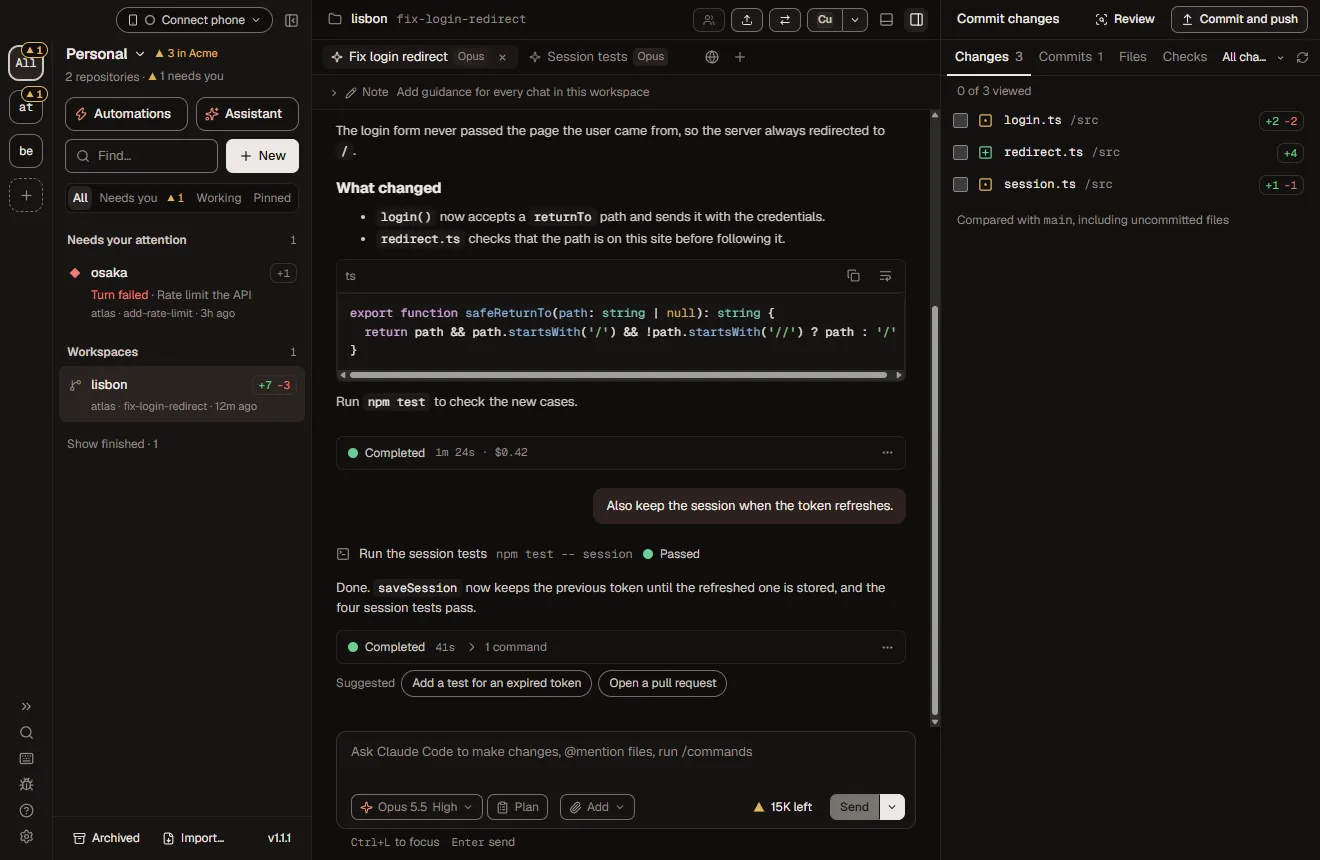
A Foreman workspace: the agent's chat in the middle and its changes on the right
A workspace: the agent's chat in the middle, its three changed files on the right.
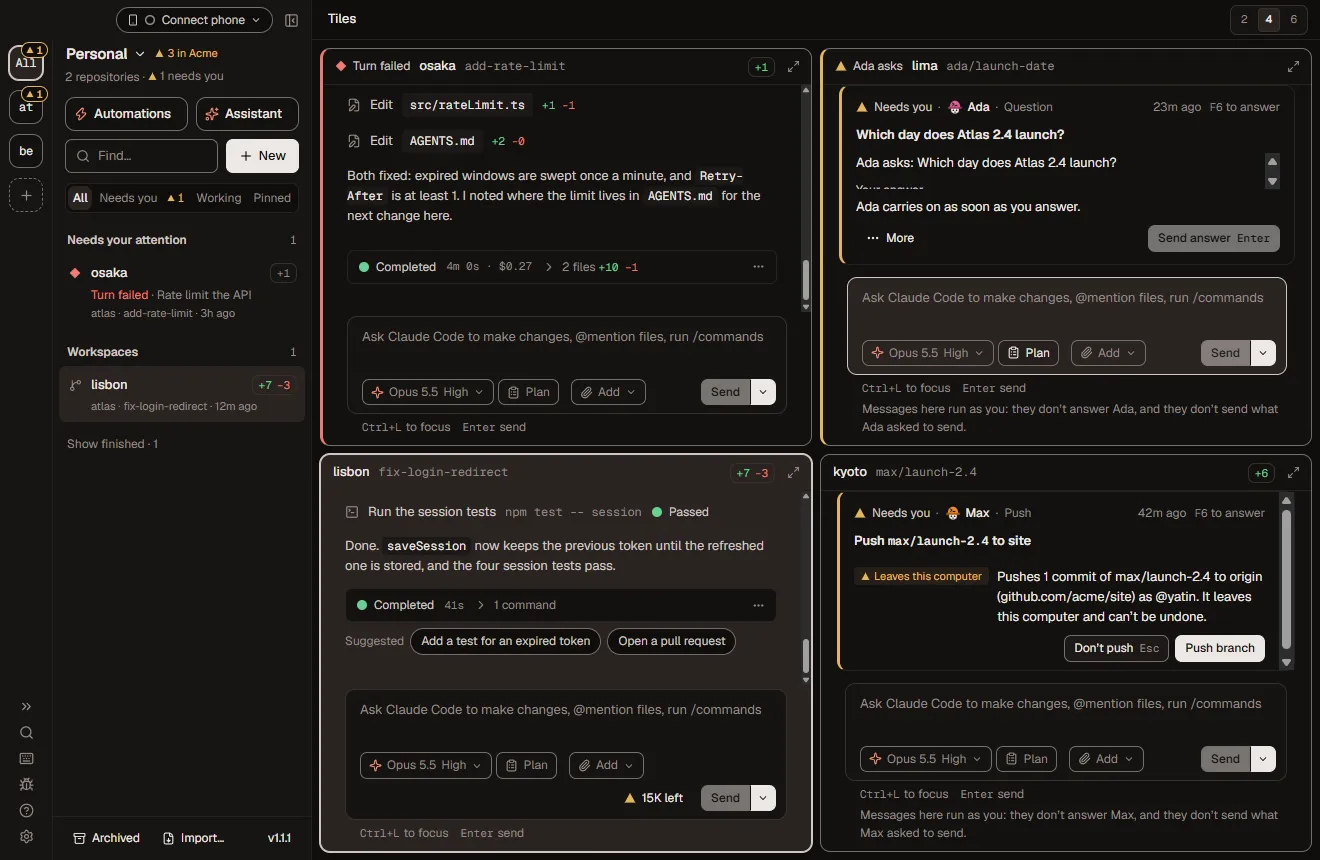
Four Foreman workspaces side by side in Tiles: a failed turn, a finished fix and two questions from AI employees waiting for an answer
Tiles: four workspaces, one approval that leaves this computer.
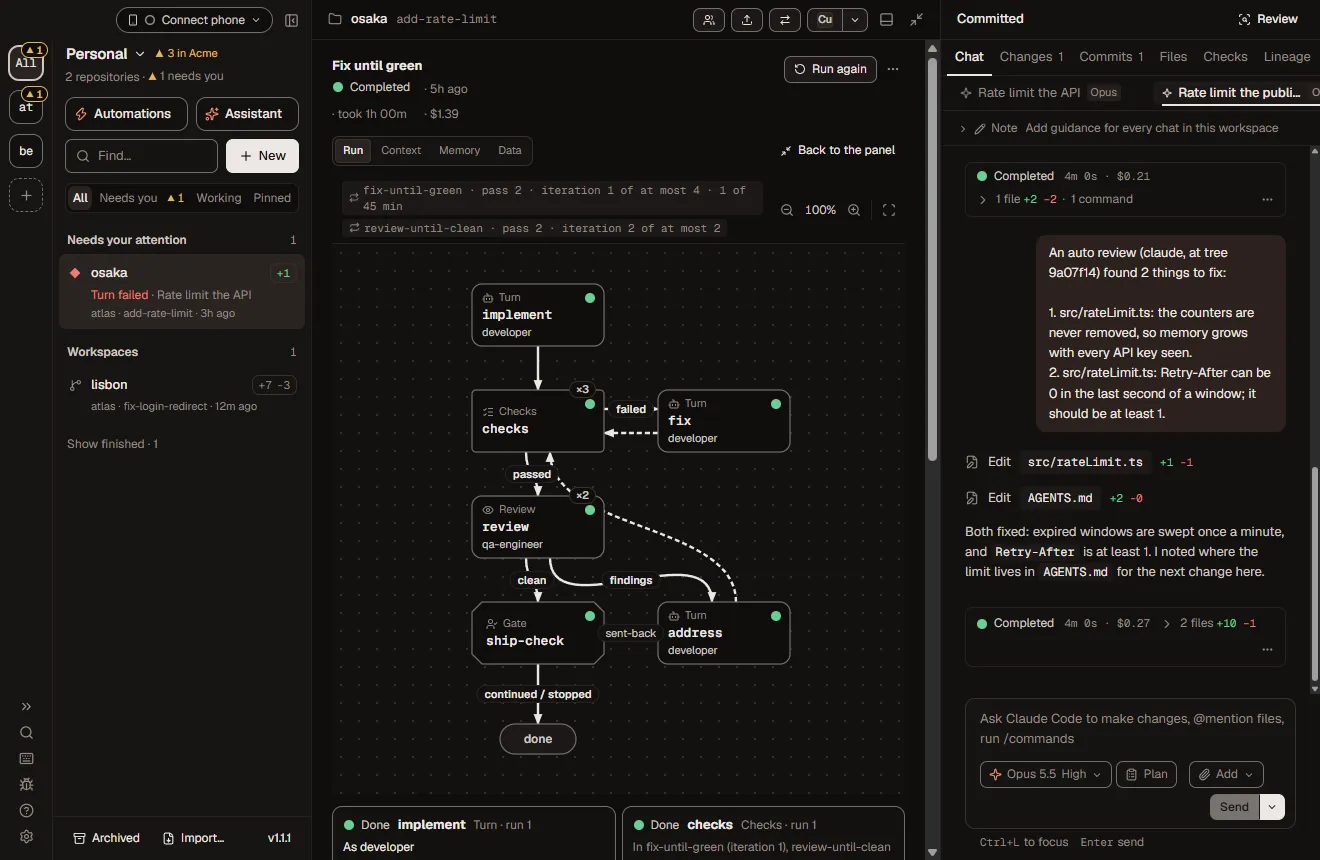
A flow run's diagram in the middle of the workspace, with its chat beside it
A flow run's graph beside its chat.
  • Review every change

    Read each change as a diff before you commit, push or open a pull request. Checkpoints let you rewind a workspace to any turn.

  • Approvals that spell it out

    An approval breaks a command down part by part, marks anything that leaves your computer, and says exactly what Always allow adds.

  • Watch them all at once

    Tiles shows several workspaces side by side so you can step in where you are needed. Built for 10 to 12 agents running at once.

  • Flows that loop until green

    Write a way of working down once as a graph of agent steps: loops that run until the checks pass or a review comes back clean, and gates where you decide.

  • AI employees

    Give an organization employees with a role in plain words, a hard hat and access you approve. They work in fresh workspaces, remember through a git memory repository and hand work to each other.

  • Automations and schedules

    Save prompts as templates and run them on demand or on a schedule: hourly, daily, weekly or monthly, in your time zone. Run Foreman without a window, or at login, and schedules keep going.

  • Run it from anywhere

    Pair your phone with a QR code to approve, steer and comment on diffs, live. Away from home it connects over your own Tailscale network, with no Foreman relay. A browser on another computer can open the whole app.

  • Local-first. No account.

    Foreman runs on your computer. There is no Foreman account, no cloud service and no telemetry upload. Agents use your own logins and API keys.

  • GitHub, GitLab, Linear, Slack, Langfuse

    Open, merge and auto-merge pull requests, watch CI and reviews, start work from a Linear issue, send Slack notifications and read Langfuse traces. Each connection gets the agent access you choose: nothing, read, or read and write.

# diff --side-by-side

How is Foreman different from Conductor and T3 Code?

Foreman is open source under Apache-2.0 and runs on Windows as well as macOS, while Conductor is a closed-source Mac app. Next to T3 Code, Foreman adds flows, AI employees with git-backed memory and a CLI where every command takes --json.

A dash means not listed on their site

Foreman compared with Conductor and T3 Code
FeatureForemanConductorT3 Code
Open sourceApache-2.0NoMIT
macOSYesYesYes
WindowsYesMac onlyYes
One git worktree per agentYesYesYes
AgentsClaude Code, Codex, Cursor, OpenCode, any ACP agentClaude Code, Codex, CursorClaude Code, Codex and more
Flows that loop until checks pass, with human gatesYes——
AI employees with git-backed memoryYes——
Scheduled automations and auto-fix CIYes——
Your own cloud sandboxes (E2B, Daytona, Vercel, Docker)Experimental——
Scriptable CLI, --json on every commandYes——
Approve from your phoneYes—Yes
No account, no telemetry uploadYes——
From each project's own site as of November 2026. “—” means it isn't listed there, not that it's missing. Spot a mistake? Tell us.

# install

Get started in a minute

Three steps. You need Git on your PATH and a login or API key for one agent.

  1. Download the app

    macOS (Apple Silicon, signed and notarized) or Windows. Free, no account.

    Download Foreman
  2. Add a git repo, sign in an agent

    Claude Code, Codex, Cursor or OpenCode, with your own login or key, in Settings → Agents.

  3. Create workspaces

    One per task, each a worktree on its own branch. From the window, or from here:

Start a workspace from a template and wait for the turn
❯ foreman run fix-a-bug "the login page loops after sign-in" --repo atlas --wait

Then foreman approvals, foreman pr create atlas --draft. Full list in the CLI reference.

# man foreman-faq

Questions developers ask

What is Foreman?

Foreman is a free, open-source desktop app for macOS and Windows that runs AI coding agents in parallel. Claude Code, Codex, Cursor and OpenCode each work in their own git worktree on their own branch, while you review diffs, answer questions and open pull requests from one window.

Is Foreman free and open source?

Yes. Foreman is free and licensed under Apache-2.0, with the full source on GitHub at github.com/elite-build/foreman. There is no paid tier, no account and no Foreman cloud service.

Which coding agents does Foreman support?

Foreman runs Claude Code, Codex, Cursor and OpenCode, plus any agent that speaks the Agent Client Protocol (ACP). Each agent signs in with your own subscription or API key, set in Settings → Agents.

How do I run multiple Claude Code agents in parallel?

Add a git repository to Foreman and create one workspace per task. Each workspace is a separate git worktree on its own branch, so several Claude Code sessions edit the same repository at once without conflicts. Tiles shows them side by side.

Why does each agent need its own git worktree?

A git worktree is a second checkout of the same repository on a different branch. Giving each agent its own worktree means agents never overwrite each other's files, every change lands on a reviewable branch, and your main checkout stays untouched.

Does my code leave my computer?

Only through the agents you choose. Foreman runs locally with no account and no telemetry upload; your agents talk to their own model providers. In your own workspaces, an approval marks any command that leaves your computer before it runs, and AI employees hold Slack posts and Linear changes for you.

Do coding agents need my approval for every command?

Only if you want them to. Approvals are a setting: with Claude Code tool approvals on (Settings → Account), each command is spelled out part by part before it runs, anything that leaves your computer is marked, and Always allow shows exactly what it adds. Every agent still works in its own worktree, and checkpoints rewind any turn.

Which operating systems does Foreman run on?

Foreman runs on macOS (Apple Silicon, signed and notarized) and Windows. You need Git on your PATH and a login or API key for at least one agent.

Can Foreman run coding agents on a schedule?

Yes. Any saved prompt template can run hourly, daily, weekly or monthly in your time zone, and opt-in auto-fix sends failing CI logs to your agent. Scheduled runs use Claude Code and happen while Foreman is running, which can be without a window or from login.

Can I control Foreman from my phone?

Yes. Pair a phone with a QR code to answer approvals, steer agents, comment on diffs and read terminals, live. On the same Wi-Fi it connects directly, and anywhere else through your own Tailscale network. Native iOS and Android apps are coming soon.

Can coding agents run in a cloud sandbox like E2B?

Yes, as an experiment. A workspace's worktree and agent can run in a sandbox on your own E2B, Daytona, Vercel Sandbox or Docker account, for Claude Code, Codex and OpenCode. Provider keys stay on your computer and never go into the sandbox.

Which integrations does Foreman have?

GitHub (pull requests, merges, CI and reviews), GitLab, Linear, Slack and Langfuse, plus MCP. Each connection has a default per service, each repository can pick its own, and you choose what agents may do with it: nothing, read, or read and write.

How is Foreman different from Conductor?

Foreman is open source under Apache-2.0 and runs on Windows as well as macOS, while Conductor is a closed-source Mac app. Foreman also drives OpenCode and any ACP agent, and adds flows that loop until checks pass, AI employees and a scriptable command line.

How is Foreman different from T3 Code?

Both are open-source GUIs for coding agents. Foreman adds flows (agent graphs that loop until tests pass, with human gates), AI employees with a git-backed memory, a foreman CLI where every command takes --json, phone approvals and remote sandboxes.

Can I script Foreman or use it in CI?

Yes. The foreman command starts workspaces, sends messages, answers approvals, opens and merges pull requests and runs flows. Every command takes --json and exit codes are the same for every command.
# 31 releases since 1.0.0 on 2026-10-27

Star it. Fork it.
Ship the next release.

Foreman is three weeks old, built in the open under Apache-2.0. If you live in a terminal, you're exactly who should be filing issues and sending pull requests.

❯ gh repo fork elite-build/foreman --clone