Run multiple AI coding agents on one well‑run site.
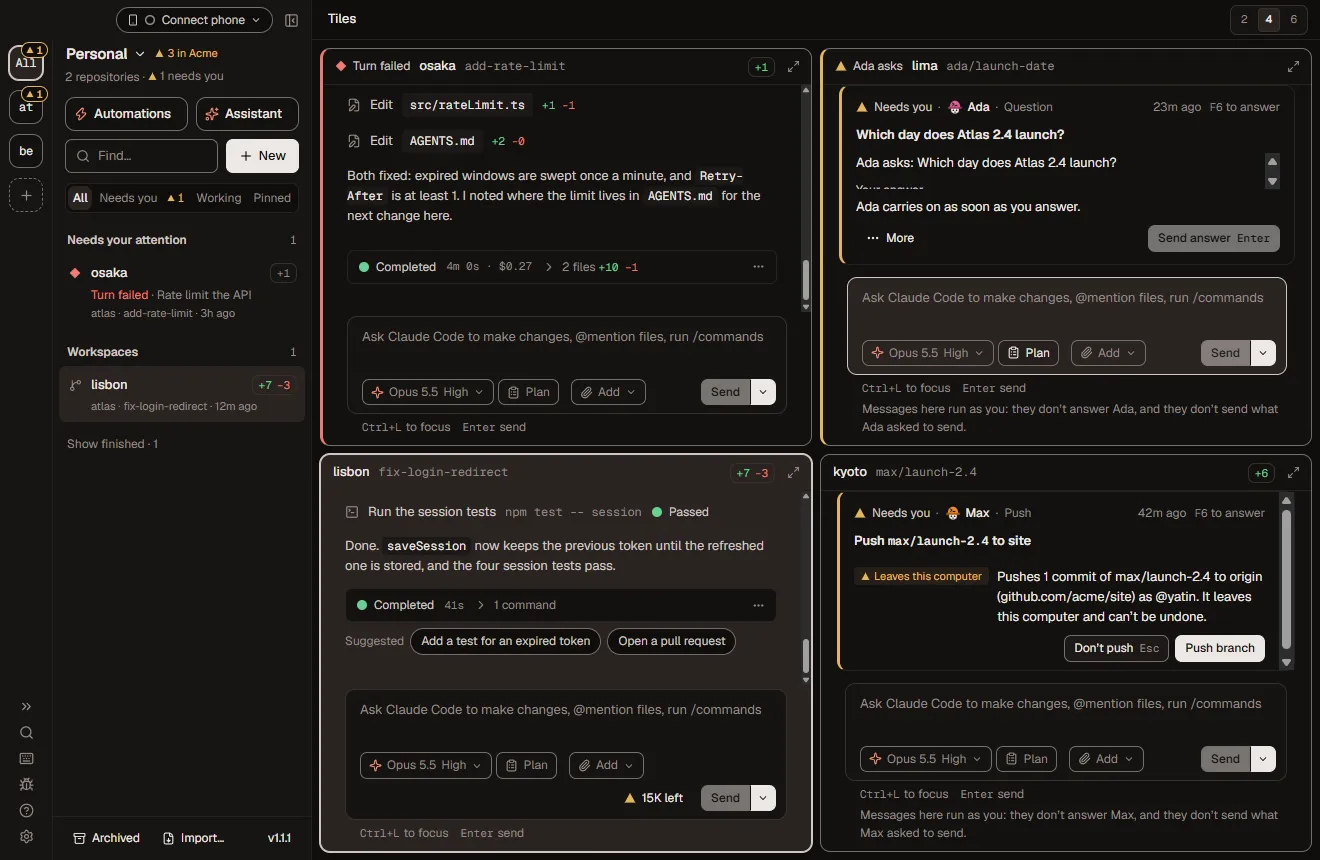
Foreman is a free, open-source desktop app for macOS and Windows that runs AI coding agents in parallel. Claude Code, Codex, Cursor and OpenCode each work in their own git worktree on their own branch, while you review diffs, answer questions and open pull requests from one window.
- Apache-2.0
- No account
- No telemetry
Site induction
How does Foreman work?
Add a git repository, then give each task a workspace: a new branch in its own git worktree, where an agent works without touching the others. Review the diff and open the pull request. For a team, make an organization and hire AI employees.
Open a folder on your computer, clone one from GitHub or start a new project. Foreman remembers where it lives and writes nothing into it.
Every task gets a workspace: a new branch in its own git worktree, with its own ports and terminal, so agents never collide.
Start as many workspaces as you like with Claude Code, Codex, Cursor or OpenCode, then read each change as a diff and open the pull request.
An organization is a space with its own repositories, AI employees and memory. Personal stays as it is.
An AI employee is a standing member of an organization: a name, a role, a hard hat, instructions, memory and the access you approve.
An organization is a space with its own repositories, AI employees and memory. Personal stays as it is.
01Crew: Parallel agents
How do you run multiple AI coding agents at once?
Give each agent its own workspace. In Foreman a workspace is a git worktree on its own branch, so several agents edit the same repository at once without touching each other's files. Their changes still go through your review, and you merge.
- Built for 10–12 at once
- 1 worktree and branch each
- 0 edits to your main checkout
Interactive demo · sample tasks
Site board · repo atlas
Assign the crew
Tap a hat or a work order. Each agent gets its own lane: a git worktree on its own branch.
- 01osaka
Open lane · waiting for a hat
fix-login-redirectClaude Code+12 −3 · ready for review
- 02lisbon
Open lane · waiting for a hat
add-rate-limitCodex+10 −1 · ready for review
- 03kyoto
Open lane · waiting for a hat
write-testsCursor+48 −0 · ready for review
- 04lima
Open lane · waiting for a hat
update-docsOpenCode+6 −2 · ready for review
4 worktrees open · 4 signed off
Away from the desk? Answer from your phoneAgents sharing a folder: none. Each agent works in its own git worktree.
02Team: AI employees
Can AI coding agents work as a team?
Yes: hire AI employees. Each one has a role in plain words, a hard hat and access you approve. They work in fresh workspaces, hand parts to each other, and remember through a private git repository with one commit per run.
Fifteen job templates · Priya, the built-in program manager, plans projects you tag her in
Open roles 15
Engineering
Design
Product
Data
Writing
Marketing
Customers
Hat rule A hat says who, never state. If a job's colour is taken, the new hire wears the least-worn colour instead.
Slack posts and Linear changes start held for you. Since v1.2.4 an employee pushes and opens draft pull requests on its own; this switch is the one-line rule that holds those too.
Your team 7
You
The person · one of the team
Approve each plan and each hire, and anything you've asked the team to hold.
Priya Lead
Program manager
Plans every project, proposes who it needs, reviews each part and accepts the result.
Ravi
Staff software engineer
Builds and fixes features, with tests, on its own branch.
Uma
Staff UX designer
Reviews screens and flows, specifies what to build and draws it as mocks.
Quinn
Staff QA engineer
Reviews what others build and says what breaks.
Sofia
Staff site reliability engineer
Keeps builds, deploys and services healthy.
Theo
Staff technical writer
Writes the docs and keeps them up to date.
Mei
Staff frontend engineer
Builds screens and components and keeps them accessible.
Omar
Staff security engineer
Reviews changes and dependencies for security risks.
Kenji
Staff software architect
Shapes the system and reviews big changes before they start.
Leo
Staff web designer
Designs and builds marketing and content sites.
Nia
Staff product manager
Recommends what to build next and writes the requirements.
Dara
Staff data analyst
Answers questions with data and specifies dashboards.
Ines
Staff copywriter
Writes release notes, launch posts and site copy.
Sam
Staff SEO specialist
Audits the site for search and suggests fixes.
Ana
Staff marketing manager
Plans launches and the messages around them.
Jonah
Staff support engineer
Triages issues and traces what users report in the code.
03Shift: Automations
Can coding agents run on a schedule overnight?
Yes. Save a prompt as a template and Foreman runs it hourly, daily, weekly or monthly in your time zone, each run in a fresh worktree. Schedules run whenever Foreman is running, even with no window open.
Unattended runs (schedules, AI employees, flow steps that write code) use Claude Code · a sleeping computer isn't woken · a run more than 5 minutes late is skipped
The seven templates that ship 7
Saved prompts yours · blanks written out
Blanks fill in order: foreman run fix-a-bug "the login page loops". A scheduled run can't stop to ask, so only templates without {{blanks}} go on a schedule. Repository templates live in.foreman/templates and travel with the code.
Schedule slipNo. 0042
nightly-triage on atlas
- Every
- in Europe/London · your zone
- Runs on
- Claude Code, a Sonnet by default
- Max
- 5 to 480
- After
- Approved
- its text, the repo's setup, checks and MCP servers
Runs every day at 00:30 (Europe/London) · stops after 30 minutes · keeps the workspace
foreman schedules add nightly-triage --repo atlas --every daily --at 00:30 --tz Europe/LondonThe CLI has no flag for AFTER: set it in the app's Schedule dialog.
Runs on Claude Code while Foreman is running.
Auto-fix CI, on a budget
Opt in, and a failing CI log goes back to your agent: two fixes per commit, five per PR. Failing CI only, not review comments.
Auto-review, read-only
Opt in per repository, and a read-only reviewer reads each finished diff. Its findings reach the agent when you click.
04Tools: Integrations
Which tools and integrations can the agents use?
GitHub, GitLab, Linear, Slack, Langfuse and MCP, plus your own sandboxes. Each connection gets the agent access you choose: nothing, read, or read and write. Slack is outbound only and Langfuse is read-only.
- GitHub
- Linear
- Slack
- Langfuse
- MCP
- Sandboxes
- GitLab
Connections belong to the repository, so every new workspace in atlas starts with this belt.
7 of 7 tools on the belt
The tags on the belt
Each tool's tag says what the agent can do with it and what stays held for you.
Still on the board
05Off-site: Cloud sandboxes. Experimental · off by default
Can agents keep working after you close the laptop?
Yes, in a sandbox on your own E2B, Daytona, Vercel Sandbox or Docker account. Turns keep going after Foreman quits, until they finish or reach the provider's session limit, and provider keys never enter the sandbox.
Needs a GitHub remote · Claude Code, Codex and OpenCode; Cursor stays home
Workspace
Runs on
- Sandbox
- E2B
- Size
- vCPU
- Starts from
- A fresh clone, set up when it’s made
- Sleeps after
- 20 min idle
- Agent sign-in
- Claude setup token
Cursor can’t run in a sandbox yet. Pick This computer, or Claude Code, Codex or OpenCode.
Codex needs an API key in a sandbox. ChatGPT sign-in is off there for now.
Your Claude subscription sign-in stays on this computer. In a sandbox Claude uses a setup token from claude setup-token, or an API key.
On E2B a session ends after 60 minutes. Foreman continues the turn when you’re around; with Foreman closed, the agent stops at the limit and the workspace sleeps.
Runs here, in a git worktree on this computer. Close the laptop and the agent stops with it.
Remote workspaces run on E2B. Experimental.
This computer
Vault
- Provider keystays here
- GitHub tokenstays here
- Agent sign-instays here
- Clone from GitHub The repository comes from its GitHub remote. GitHub’s token goes in as that one command’s environment.
- Install the agent host Foreman puts its small agent host in the sandbox, so the agent can run there without your computer.
- Set up The install script and the repository’s setup steps run, as they would in a local worktree.
- Run The agent takes the turn in the sandbox. Your computer only coordinates.
Session · not started
Turn · waiting to ship
- Pick a workspace and a container, then Create. Closing the laptop quits Foreman: remote turns go on in their sandboxes until they finish or reach the session limit, and their chats catch up when you open Foreman again.
This month · no sandbox time yet
06Plans: Flows. Experimental · off by default
How do you make agents loop until the tests pass?
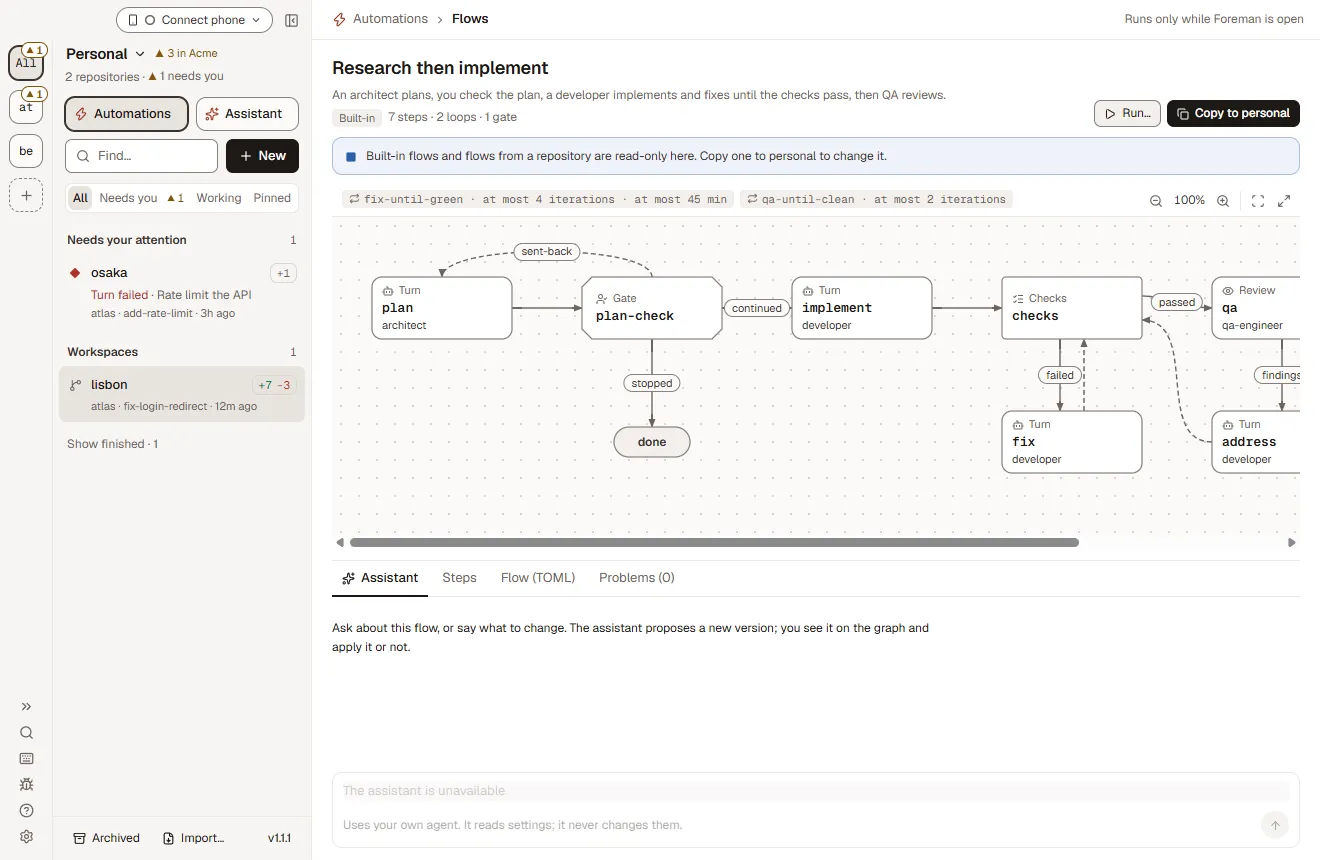
Draw it as a flow: a graph of agent steps with loops that run until the checks pass or a review comes back clean, and gates where you decide. Foreman ships 11 built-in flows, and every loop has a limit.
 The drawing's stamp. Press to stamp it again.
- I plan the change. I never touch the files.
- I build it, then fix it until the checks pass.
- I find problems. Fixing them isn't my job.
- Nothing ships until I open the gate.
The architect plans, the developer builds, the checks run until green, at most 4 rounds, the QA engineer reviews until clean, and I approve before a draft PR.
Tap any underlined part to change it.
Who plans?
Who builds?
How many rounds may the checks take?
Who reviews?
Where do you step in?
A flow of your own. Closest built-in: research-then-implement. Ask the assistant and it drafts this file for you.
Ready · 7 rooms · 3 loops · 1 gate
.foreman/flows/my-blueprint.tomlSimplified for this page# .foreman/flows/my-blueprint.toml · simplified for this page
name = "My blueprint"
description = "The architect plans, the developer builds, the checks run until green, at most 4 rounds, the QA engineer reviews until clean, and I approve before a draft PR."
[inputs]
task = "The issue to resolve: its link or its words"
[start]
step = "plan"
[steps.plan]
kind = "turn"
persona = "architect" # read-only: plans, never edits
prompt = "Research how to do this and write a plan. Don't change any files yet. {{task}}"
context = ["task", "tree"]
[steps.implement]
kind = "turn" # code steps run on Claude Code
persona = "developer"
loadout = 1
prompt = "Implement the plan."
context = ["plan.answer"]
[steps.checks]
kind = "checks" # the repo's approved check commands, never an agent
[steps.fix]
kind = "turn"
same_tab = "implement"
prompt = "Address what failed or what you were sent back for, and run the checks again."
context = ["checks.results"]
[steps.review]
kind = "review" # read-only: Claude Code or Codex
persona = "qa-engineer"
# its default loadout 3 is Codex
context = ["diff"]
[steps.address]
kind = "turn"
same_tab = "implement"
context = ["review.findings"]
[steps.pr-check]
kind = "gate" # you: Continue, Send back or Stop
show = ["diff", "checks.results", "review.findings"]
ask = "Open a draft PR?"
[steps.pr]
kind = "pr" # Foreman pushes and opens it, no agent
draft = true
body = "{{ledger}}"
[steps.ci]
kind = "wait"
on = "ci"
[steps.fix-ci]
kind = "turn"
same_tab = "implement"
prompt = "CI failed on the pull request. Fix it, commit and push."
[edges]
plan = "implement"
implement = "checks"
checks = { passed = "review", failed = "fix" }
fix = "checks"
review = { clean = "pr-check", findings = "address" }
address = "checks"
pr-check = { continued = "pr", sent-back = "address", stopped = "done" }
pr = { opened = "ci" }
ci = { green = "done", none = "done", failed = "fix-ci" }
fix-ci = "ci"
[loops.fix-until-green]
over = ["checks", "fix"]
at_most = { iterations = 4, minutes = 45 }
iteration = "same-tab" # or "compact-when-full" or "fresh-with-summary"
[loops.review-until-clean]
over = ["review", "address", "checks"]
at_most = { iterations = 2 }
[loops.ci-until-green]
over = ["ci", "fix-ci"]
at_most = { iterations = 2 }
[after]
workspace = "keep" # keep | archive | delete-unchanged- Project
- atlas
- Flow
my-blueprint- Drawn by
- the assistant
- Checked by
- you
- Revisions
- A first drawn
Scale: 1 step = 1 room · persona hats drawn for this page
Site log fix-login-redirect
- 00:08architect: a 3-step plan · the cookie is set after the redirect in src/auth/session.ts
- 00:45developer: moved the redirect after setSession() · +12 −3
- 01:22checks: ✕ auth/redirect.test.ts › keeps returnTo after sign-in
- 01:59developer (fix, same tab): kept returnTo on the refresh path · +4 −1
- 02:36checks: ✓ 214 tests · types · lint
- 03:13qa-engineer: clean, no findings
- 03:50pr-check: waiting for you · open a draft PR?
Illustrative run of the sentence above. In Foreman the Flow tab draws it live and the gate waits in Needs you. Flows are experimental: turn them on in Settings → Experimental → Flows.
Legend
- A room is a step: a turn, checks, a review, a gate or a PR
- A loop, with its bound and the fact that sends it round
- Sent back from your gate, with your note
- Your gate is a door: nothing passes until you open it
- The job, walking from room to room on a run
07Loadout: Pick your agents
Which agent should you send for which job?
Claude Code writes the code. A second model reviews it read-only, and you keep the gate. Pick a job and the dealer hands out the crew, with the built-in flow it plays as.
The job
Loadout for fix flaky tests
- DeveloperClaude CodeAgent · Anthropic
Writes the fix. Flow steps that change code run on Claude Code, the one agent Foreman runs unattended.
- ReviewerCodexAgent · OpenAI
Reads the diff read-only, inside its own sandbox. A flow’s review steps can run on Codex.
- Review personaqa-engineerFlow persona · reviewer
What the reviewer wears: it finds what breaks, never fixes it, and ends with findings.
- At the gateYouThe foreman · one of one
Quarantine the test, keep the fix, or send it back with a note. Nothing ships before you look.
Plays as the built-in flow flaky-test-triage. Flows are experimental and off by default: Settings → Experimental.
Run them side by side in Foreman, each in its own worktree.
Loadout for try one task three ways
- Workspace osakaClaude CodeAgent · Anthropic
Takes the prompt in a worktree of its own, on its own branch.
- Workspace lisbonCodexAgent · OpenAI
Same prompt, its own worktree and branch, so nothing collides.
- Workspace kyotoCursorAgent · Anysphere
Same prompt again, as an interactive pair. Foreman reviews what it does.
- The judgeYouThe foreman · one of one
Read the three diffs side by side in Tiles and keep the one you like. Nothing merges by itself.
No flow needed: three workspaces, one prompt.
Run them side by side in Foreman, each in its own worktree.
Loadout for security pass before a release
- DeveloperClaude CodeAgent · Anthropic
Builds, then fixes until the checks pass, round after round, within the loop’s bounds.
- First reviewqa-engineerFlow persona · reviewer
Reads the tree first: does the change do what was asked?
- Second reviewsecurity-reviewerFlow persona · reviewer
Reads the same tree for injection, secrets and unsafe defaults. Any finding goes back.
- At the gateYouThe foreman · one of one
Both reviews come back clean, then you look. Nothing leaves before that.
Plays as the built-in flow two-reviewers. Flows are experimental and off by default: Settings → Experimental.
Run them side by side in Foreman, each in its own worktree.
Loadout for plan a whole feature
- Program managerPriyaEmployee · Program manager
Tag @Priya in Channels. She asks her questions first, then draws the plan as a workflow.
- Design partUmaEmployee · Staff UX designer
Specifies the screens and draws two HTML mock options for each design part.
- Build partRaviEmployee · Staff software engineer
Builds it with tests on its own branch, and opens a draft PR without waiting.
- Approves the planYouThe foreman · one of one
Nothing starts until you approve the plan. Slack posts and Linear changes wait for you.
Plays as a project in Channels, on Claude Code.
Priya runs the parts that don’t depend on each other side by side, in one shared workspace.
Phone: Remote control
Can you run Foreman from your phone?
Yes. Pair a phone with a QR code to answer approvals, plans and flow gates, steer agents and comment on diffs, live. On the same Wi‑Fi it connects directly; anywhere else, over your own Tailscale network. There is no Foreman relay.
- WatchSees everything, changes nothing.
- OperateDefaultAnswers approvals, plans, questions and flow gates. Steers, comments on diffs, reads terminals.
- Full controlAlso settings, repositories and keys. Meant for a browser at /app.
A browser on another computer opens the whole app at /app. Run Foreman with no window, or from login with foreman service install. The phone reads terminals but can't type into them.
Native iPhone and Android apps are on the way.
- iOS appComing soon
- Android appComing soon
- Watch the repo for the release
Today: pair your phone with a QR code and add the phone view to your Home Screen.
lisbon · Codex
Plan ready: rate-limit the login
- Add a limiter to
/api/login - Answer 429 with Retry-After
- Add a limiter to
Same Wi‑Fi · Operate
Illustrative Finish a lane on the board at station 01, or run the flow at station 06 to its gate, and the card lands here.
Other sites
How is Foreman different from Conductor and T3 Code?
Foreman is open source under Apache-2.0 and runs on Windows as well as macOS, while Conductor is a closed-source Mac app. Next to T3 Code, Foreman adds flows that loop until checks pass, AI employees with git-backed memory and a CLI where every command takes --json.
—A dash means not listed on their site
| Feature | Foreman | Conductor | T3 Code |
|---|---|---|---|
| Open source | Apache-2.0 | No | MIT |
| macOS | Yes | Yes | Yes |
| Windows | Yes | Mac only | Yes |
| One git worktree per agent | Yes | Yes | Yes |
| Agents | Claude Code, Codex, Cursor, OpenCode, any ACP agent | Claude Code, Codex, Cursor | Claude Code, Codex and more |
| Flows that loop until checks pass, with human gates | Yes | — | — |
| AI employees with git-backed memory | Yes | — | — |
| Scheduled automations and auto-fix CI | Yes | — | — |
| Your own cloud sandboxes (E2B, Daytona, Vercel, Docker) | Experimental | — | — |
| Scriptable CLI, --json on every command | Yes | — | — |
| Approve from your phone | Yes | — | Yes |
| No account, no telemetry upload | Yes | — | — |
Induction
Get started in a minute
Download the app, point it at a git repository, and give each task its own workspace.
Download Foreman
Free for macOS (Apple Silicon, signed and notarized) and Windows. You need Git on your PATH.
Download ForemanAdd a repo, sign in an agent
Pick any git repository. Sign in Claude Code, Codex, Cursor or OpenCode in Settings → Agents with your own login or key.
Create workspaces
One per task, each a fresh worktree on its own branch. Watch them in Tiles, review the diff, open the PR.
foreman run fix-a-bug "the login page loops after sign-in" --repo atlas --wait
# Start a workspace from a template and wait for the turn
foreman approvals
# See what is waiting for youCLI reference · exit codes are the same for every command
What is Foreman?
Foreman is a free, open-source desktop app for macOS and Windows that runs AI coding agents in parallel. Claude Code, Codex, Cursor and OpenCode each work in their own git worktree on their own branch, while you review diffs, answer questions and open pull requests from one window.
Is Foreman free and open source?
Yes. Foreman is free and licensed under Apache-2.0, with the full source on GitHub at github.com/elite-build/foreman. There is no paid tier, no account and no Foreman cloud service.
Which coding agents does Foreman support?
Foreman runs Claude Code, Codex, Cursor and OpenCode, plus any agent that speaks the Agent Client Protocol (ACP). Each agent signs in with your own subscription or API key, set in Settings → Agents.
How do I run multiple Claude Code agents in parallel?
Add a git repository to Foreman and create one workspace per task. Each workspace is a separate git worktree on its own branch, so several Claude Code sessions edit the same repository at once without conflicts. Tiles shows them side by side.
Why does each agent need its own git worktree?
A git worktree is a second checkout of the same repository on a different branch. Giving each agent its own worktree means agents never overwrite each other's files, every change lands on a reviewable branch, and your main checkout stays untouched.
Does my code leave my computer?
Only through the agents you choose. Foreman runs locally with no account and no telemetry upload; your agents talk to their own model providers. In your own workspaces, an approval marks any command that leaves your computer before it runs, and AI employees hold Slack posts and Linear changes for you.
Do coding agents need my approval for every command?
Only if you want them to. Approvals are a setting: with Claude Code tool approvals on (Settings → Account), each command is spelled out part by part before it runs, anything that leaves your computer is marked, and Always allow shows exactly what it adds. Every agent still works in its own worktree, and checkpoints rewind any turn.
Which operating systems does Foreman run on?
Foreman runs on macOS (Apple Silicon, signed and notarized) and Windows. You need Git on your PATH and a login or API key for at least one agent.
Can Foreman run coding agents on a schedule?
Yes. Any saved prompt template can run hourly, daily, weekly or monthly in your time zone, and opt-in auto-fix sends failing CI logs to your agent. Scheduled runs use Claude Code and happen while Foreman is running, which can be without a window or from login.
Can I control Foreman from my phone?
Yes. Pair a phone with a QR code to answer approvals, steer agents, comment on diffs and read terminals, live. On the same Wi-Fi it connects directly, and anywhere else through your own Tailscale network. Native iOS and Android apps are coming soon.
Can coding agents run in a cloud sandbox like E2B?
Yes, as an experiment. A workspace's worktree and agent can run in a sandbox on your own E2B, Daytona, Vercel Sandbox or Docker account, for Claude Code, Codex and OpenCode. Provider keys stay on your computer and never go into the sandbox.
Which integrations does Foreman have?
GitHub (pull requests, merges, CI and reviews), GitLab, Linear, Slack and Langfuse, plus MCP. Each connection has a default per service, each repository can pick its own, and you choose what agents may do with it: nothing, read, or read and write.
How is Foreman different from Conductor?
Foreman is open source under Apache-2.0 and runs on Windows as well as macOS, while Conductor is a closed-source Mac app. Foreman also drives OpenCode and any ACP agent, and adds flows that loop until checks pass, AI employees and a scriptable command line.
How is Foreman different from T3 Code?
Both are open-source GUIs for coding agents. Foreman adds flows (agent graphs that loop until tests pass, with human gates), AI employees with a git-backed memory, a foreman CLI where every command takes --json, phone approvals and remote sandboxes.
Can I script Foreman or use it in CI?
Yes. The foreman command starts workspaces, sends messages, answers approvals, opens and merges pull requests and runs flows. Every command takes --json and exit codes are the same for every command.
The site is open source. Pick up a shovel.
31 releases since 1.0.0 on 27 October, and every station on this page is code you can read under Apache-2.0. Star it to bookmark Foreman, watch releases for updates, fork it, or take a first issue and join the crew.